Summary Table
| Adapter characteristics | Overall dimensions | 28.75 x 16.25 mm |
| Electrode interface | BM54B3.0-30DS-0.4V OR A79025-001 | |
| Power consumption | < 300 mW | |
| Cable interface | USB-C | |
| NYX1-512 recording characteristics | Recording channels | Up to 512 |
| Bandwidth | 3.8 Hz – 14 kHz (Configurable) | |
| Gain | 12.5 – 200 V/V (Configurable) | |
| Input referred noise | 4.5 μVrms min. | |
| Bit depth | 10 – 16 bits (Configurable) | |
| Sampling rate | 2 – 32 kHz (Configurable) | |
| Input capacitance | 6.8 pF | |
| LUX1-16K stimulation characteristics | Stimulation pixels | Up to 16,384 |
| Resolution | 128 × 128 | |
| DAC resolution | 7 bits per column | |
| Current drive range | 0–127 µA (1 µA per LSB) | |
| SPI clock | ≤ 24 MHz |
Hardware Requirements
- An active neural probe with a BM54F3.0-30DP-0.4V(51) or A79024-001 connector in one of the following configurations of components:
- A SciFi wireless headstage.
- A WiFi network capable of WiFi 5 (802.11ac) or later. To get best performance, use WiFi 6 (802.11ax 160MHz).
- A PC running the synapsectl command line tool or the Synapse Headstage GUI application.
Connector Pinout
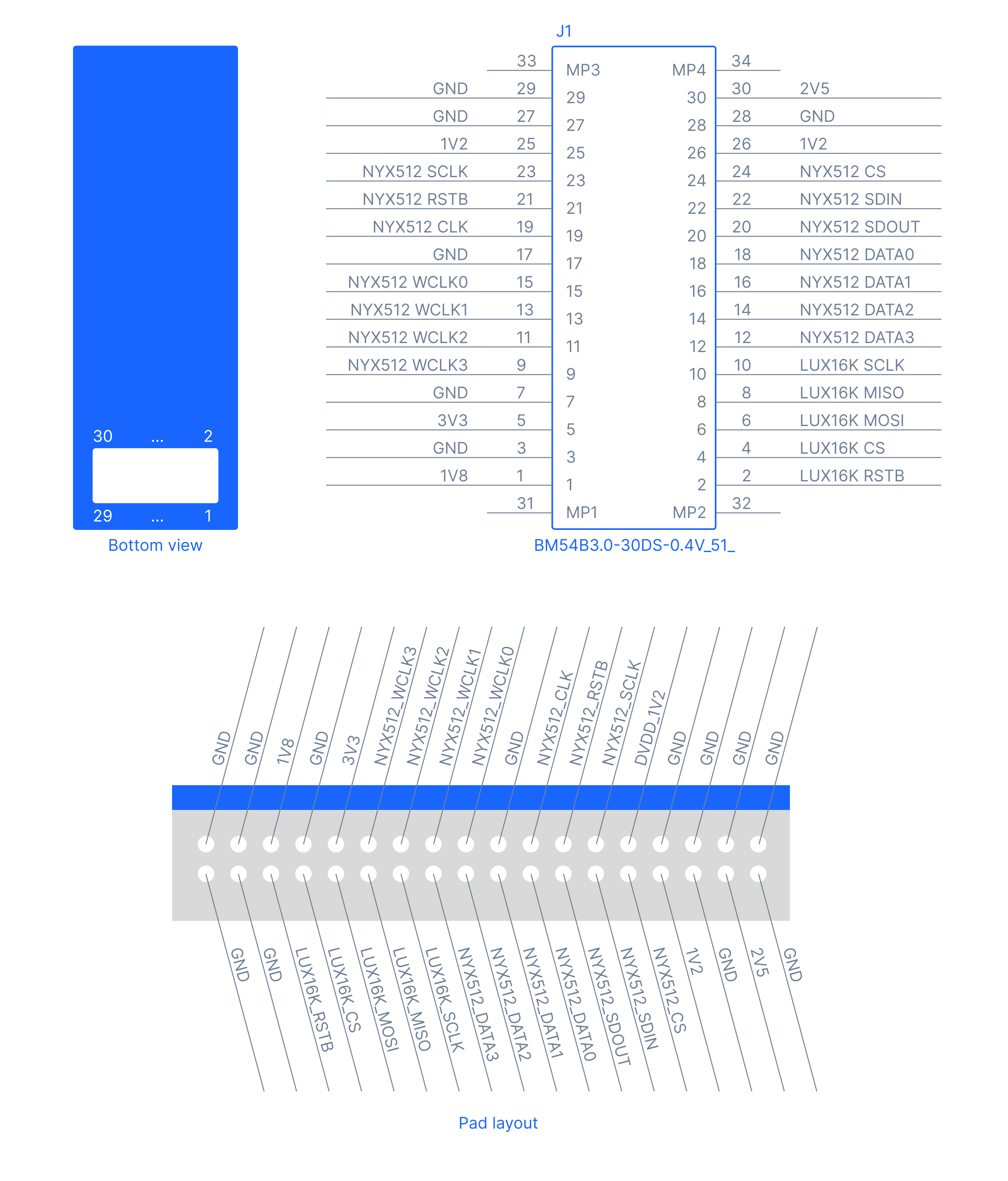
| Pin | Signal | Pin | Signal |
|---|---|---|---|
| 1 | 1V8 | 2 | LUX1-16K RSTB |
| 3 | GND | 4 | LUX1-16K CS |
| 5 | 3V3 | 6 | LUX1-16K MOSI |
| 7 | GND | 8 | LUX1-16K MISO |
| 9 | NYX1-512 WCLK3 | 10 | LUX1-16K SCLK |
| 11 | NYX1-512 WCLK2 | 12 | NYX1-512 DATA3 |
| 13 | NYX1-512 WCLK1 | 14 | NYX1-512 DATA2 |
| 15 | NYX1-512 WCLK0 | 16 | NYX1-512 DATA1 |
| 17 | GND | 18 | NYX1-512 DATA0 |
| 19 | NYX1-512 CLK | 20 | NYX1-512 SDOUT |
| 21 | NYX1-512 RSTB | 22 | NYX1-512 SDIN |
| 23 | NYX1-512 SCLK | 24 | NYX1-512 CS |
| 25 | 1V2 | 26 | 1V2 |
| 27 | GND | 28 | GND |
| 29 | GND | 30 | 2V5 |
| 31 | MP1 (mounting pad) | 32 | MP2 (mounting pad) |
| 33 | MP3 (mounting pad) | 34 | MP4 (mounting pad) |